The differences between IPA styles explained

Updated: Jan 3
We often hear, "I don't like IPAs." But usually, that means: I've tasted one type of IPA and think they're all the same. That's a shame, because IPA isn't a flavor, but a collective term. And within that category, the differences are significant.
The most well-known distinction is between West Coast IPA and East Coast IPA. And later, another style was added: New England IPA. Time to clarify that distinction.
Back in time
To understand the difference between the various IPA styles, we need to go back to the rise of craft beer in the United States .
In the 1980s, the first craft brewers began to rebel against industrial beer. Initially, they primarily brewed pale ales, but soon began exploring forgotten and classic beer styles. Porter and stout returned, and wheat beers , inspired by the German Weissbier, also appeared .
The IPA also emerged during this period . Not yet as an extreme hop bomb, but primarily as an extra-hoppy Pale Ale : recognizable, dry, and easy to drink.
Because the craft beer revolution began on the West Coast of the US (California, Oregon, Washington), this automatically became the basis for what we later came to call the West Coast IPA. Early breweries included Anchor Brewing and Sierra Nevada Brewing Company.
The difference between IPA types explained
In those early years, brewers primarily used the so-called C-hops . It started with Cascade (considered by many brewers to be the hop that defined the American beer style), followed by Chinook and Centennial .
Key detail: the difference between the various types of IPAs wasn't so much which hops were used, but how they were used.
West Coast IPA: bitter and tight
Over the course of the 1990s, West Coast IPAs became increasingly dry, bitter, and sharper. IBU values rose from roughly 40–60 to 60–80, and sometimes even higher .
Features:
Dry fermentation
Higher perceived bitterness
Hop as the main character
This became the classic West Coast IPA : clear, distinct and uncompromising.
East Coast IPA: response and balance
East Coast breweries responded to this development, creating IPAs that offered more balance :
More malt body
Slightly lower in bitterness
Rounder mouthfeel
They often used the same hop varieties , but in a different way:
Fewer late hop doses
More focus on structure than on aggression
Sometimes supplemented with European hop varieties
This is what we call the East Coast IPA. Clear, classic, and balanced. A style that was especially popular around 2000–2008 .
New England IPA: a style break
Only after 2010 did something completely different emerge: the New England IPA (NEIPA) .
This isn't a further development of the East Coast IPA, but it does build on that style culturally and geographically. It's a conscious break from everything IPA has ever been.
Features:
Hazy
Soft mouthfeel (due to oats and wheat)
Low bitterness
Explosive hop aroma
New American hop varieties play a major role here, such as Simcoe, Amarillo, Citra, and Mosaic . These hops provide the familiar juicy and fruity character .
IPA today: anything goes
IPA has become a playing field. There are countless variations, such as:
Black IPA
Red IPA
White IPA
Session IPA
Double and Triple IPA
Sour IPA
Not all of them are permanent, but all are part of the IPA evolution.
How can you tell what kind it is when it only says “IPA”?
If the label of the can or bottle only says IPA, you need to read between the lines. Pay attention to the description, the terms used, the hop varieties and the appearance of the beer. Words like bitter, dry or juicy often say more than the name. As mentioned before, IPA is not a single flavour but a collection of styles. And the label usually tells you more than the name.
IPA and alcohol-free
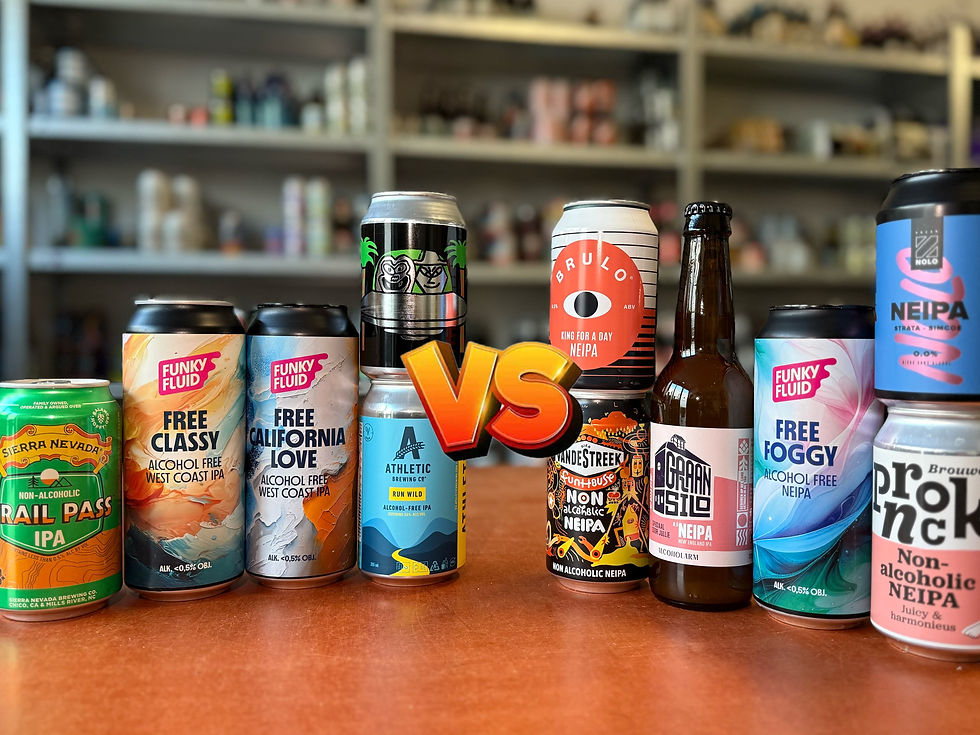
Among non-alcoholic beers, IPA is the most common style. This makes sense: hops add flavor, structure, and tension, exactly what alcohol normally does.
But here too, one IPA is not the same as another.
Is it a jaw-dropping West Coast IPA or a smooth, juicy New England IPA? Both are delicious, as long as you know what you're drinking.


Comments